Understanding Dr. Mike Rizzo’s Approach to Learning and Neurodiversity
For more than 35 years, Dr. Michael Rizzo has worked with children whose intellectual potential is often far greater than their performance in traditional educational settings might suggest. His approach begins with a simple but important premise:
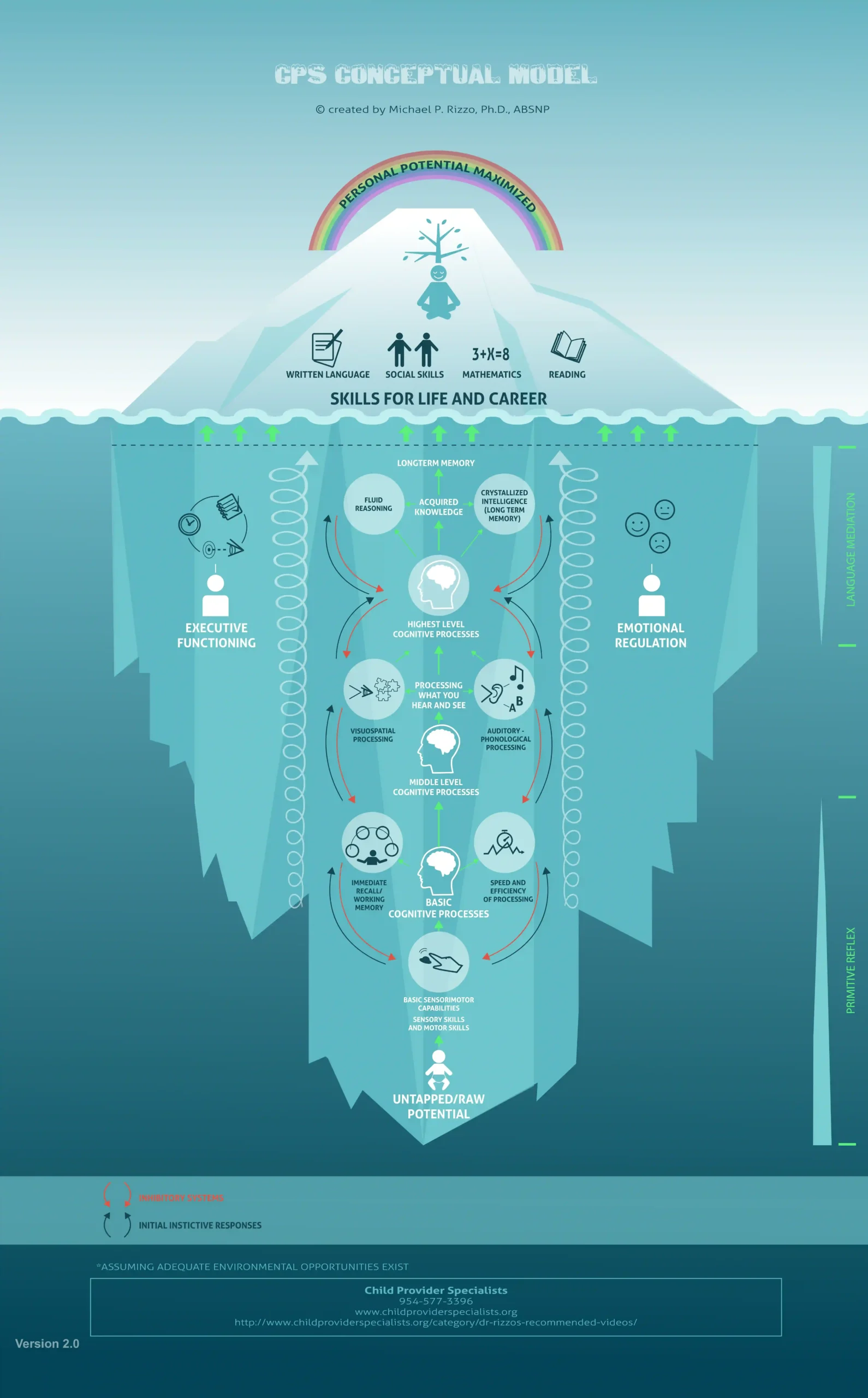
A child’s performance is the end product of many different brain systems. When a child struggles, the difficulty we observe does not necessarily tell us what is causing it.
Rather than beginning with labels such as lazy, unmotivated, oppositional, or even simply ADHD or learning disabled, Dr. Rizzo’s approach asks a more useful question:
How does this child’s brain take information in, process it, organize it, store it, retrieve it, and ultimately express what it knows?
Intelligence and School Performance Are Not the Same Thing
A child can possess very high intellectual ability while simultaneously having weaknesses in specific cognitive systems required for conventional schoolwork.
A bright student may understand complex concepts in science, history, mathematics, or literature and yet have tremendous difficulty writing a two-page paper, completing homework independently, organizing materials, remembering assignments, or reading efficiently.
This apparent contradiction becomes easier to understand when intelligence is separated from the individual cognitive systems required to perform a particular task.
Dr. Rizzo often conceptualizes these systems as a child’s cognitive tool kit. These tools can include attention and executive functioning, working memory, processing speed, auditory processing, language, memory, nonverbal reasoning, sensorimotor abilities, reading, written expression, and other information-processing functions.
Two children with similar intelligence, or even the same diagnosis, can therefore have very different learning profiles.
The Importance of Executive Function
Executive functions help a child translate knowledge and intention into action. They include the ability to:
· initiate a task;
· sustain attention and effort;
· organize materials and information;
· hold information in working memory;
· inhibit distractions and impulses;
· shift efficiently between tasks;
· plan several steps ahead; and
· monitor whether a strategy is actually working.
This helps explain why a highly capable child may understand exactly what needs to be done yet still have difficulty doing it consistently.
The problem may not be comprehension.
The bottleneck may occur between knowing what to do and reliably executing it.
“There Is No Such Thing as a Lazy Child”
One of the central principles in Dr. Rizzo’s clinical philosophy is his reluctance to accept “lazy” as an explanation for chronic underperformance.
This does not mean that children never avoid work or make poor choices. Rather, when a child repeatedly fails to perform at a level adults believe should be possible, simply labeling the child as lazy or unmotivated may confuse the symptom with the cause.
Instead of asking:
“Why won’t this child do it?”
Dr. Rizzo encourages parents, educators, and clinicians to ask:
“What cognitive demand is this task placing on the child that may be disproportionately difficult?”
That change in perspective can dramatically alter how adults respond to struggling children.
When Academic Difficulties Become Emotional Difficulties
Over time, repeated failure can become far more than an academic issue.
A child may repeatedly:
try → perform below expectations → experience criticism or disappointment → try again → continue to struggle → begin doubting himself or herself → eventually avoid the task altogether.
What adults later see as anxiety, procrastination, oppositional behavior, emotional dysregulation, school avoidance, or lack of motivation may sometimes be the downstream consequence of years spent struggling in an environment poorly matched to the child’s cognitive profile.
The emotional response can eventually become as significant as the original learning difficulty.
Remediate the Weakness, But Protect the Child’s Ability to Learn
Another important part of Dr. Rizzo’s approach is distinguishing between remediating a weakness and allowing that weakness to restrict a child’s intellectual development.
For example, a student with a significant reading disorder may continue receiving appropriate reading intervention while also gaining access to sophisticated information through audiobooks or text-to-speech technology.
Likewise, a student whose ability to generate ideas greatly exceeds his or her ability to produce written language may benefit from speech-to-text technology.
In practical terms, some children can effectively “read with their ears” and “write with their voices.”
The goal is not to abandon remediation. It is to prevent a particular area of weakness from unnecessarily becoming the ceiling on everything the child is allowed to learn.
Change the Environment as Well as the Child
Traditional education sometimes asks:
“This is how school works. How do we make the child fit?”
Dr. Rizzo’s approach asks a different question:
“Given this child’s cognitive architecture, how can we adjust instruction, assessment, expectations, technology, and supports so that the child can more accurately demonstrate what he or she knows?”
The objective is not to lower expectations. It is to create a better goodness of fit between the learner and the environment.
Hunters and Villagers: A Way of Thinking About Cognitive Diversity
One of the metaphors Dr. Rizzo has used to help explain differences in attentional style is the idea of “hunters and villagers.”
The metaphor should not be interpreted as a formally established scientific theory that people with ADHD literally evolved to become hunters. Rather, it offers an accessible way of thinking about why different cognitive styles may have had value throughout human history.
The “villager” cognitive style is particularly compatible with sustained, predictable and repetitive activity. These individuals may be especially comfortable following routines, completing sequential tasks, maintaining organization, planning ahead, and persisting with activities that do not provide immediate stimulation.
These characteristics also happen to be highly rewarded in modern classrooms and workplaces.
The “hunter” cognitive style, by contrast, may be particularly responsive to novelty, change, urgency, environmental cues and immediate feedback. Attention may shift rapidly toward new information, and engagement may increase dramatically when something is interesting, stimulating or important.
In an environment requiring continuous awareness of changing surroundings, rapidly noticing movement or shifting attention could be extremely useful.
In a traditional classroom, however, the same characteristics may appear as distractibility, impulsivity, inconsistent attention or difficulty completing repetitive work.
Research supports ADHD as a highly heritable neurodevelopmental condition involving differences in attentional control, executive functioning, inhibition and reward processing. The idea that some ADHD-associated characteristics may have provided advantages in certain ancestral environments remains an interesting evolutionary hypothesis rather than an established scientific conclusion.
The larger point is more important:
Human beings do not all possess identical cognitive architectures, yet many educational environments reward a relatively narrow range of cognitive styles.
Understanding those differences allows us to move beyond simply identifying what a child cannot do and toward understanding how that child can learn most effectively.